A new patio is one of those home improvements that gets used far more than expected — and gets put off far longer than it should. Done properly, it transforms how you use your garden and adds real kerb appeal to the property. Done poorly, with an inadequate sub-base or incorrect drainage falls, you'll have a sunken, waterlogged surface within a couple of years. The cost depends on the material you choose, the size of the area, what's underneath, and what the ground conditions are like.
Patio materials and what they cost in the North East
These are realistic supply-and-fit costs per square metre in Newcastle, Durham, Sunderland and the wider North East. They include excavation, sub-base, laying and jointing — not just the material cost alone.
- Concrete block paving — from £45 to £70 per m²
- Natural sandstone or Indian stone — from £55 to £85 per m²
- Porcelain paving — from £65 to £100 per m²
- Natural slate — from £70 to £95 per m²
- Concrete paving slabs (budget) — from £35 to £55 per m²
- Self-binding gravel — from £20 to £40 per m²
When comparing quotes, make sure they include the sub-base preparation, edge restraints and jointing — not just the material and laying. Many low quotes exclude the groundworks entirely, making them look cheaper than they are.
What does a complete patio installation cost?
To give a realistic sense of total project cost, here are complete patio installation prices for typical sizes across the North East.
- Small patio (15–20m²), natural sandstone — £900 to £1,700
- Medium patio (20–35m²), porcelain — £1,500 to £3,500
- Large patio (35–60m²), block paving — £2,000 to £4,200
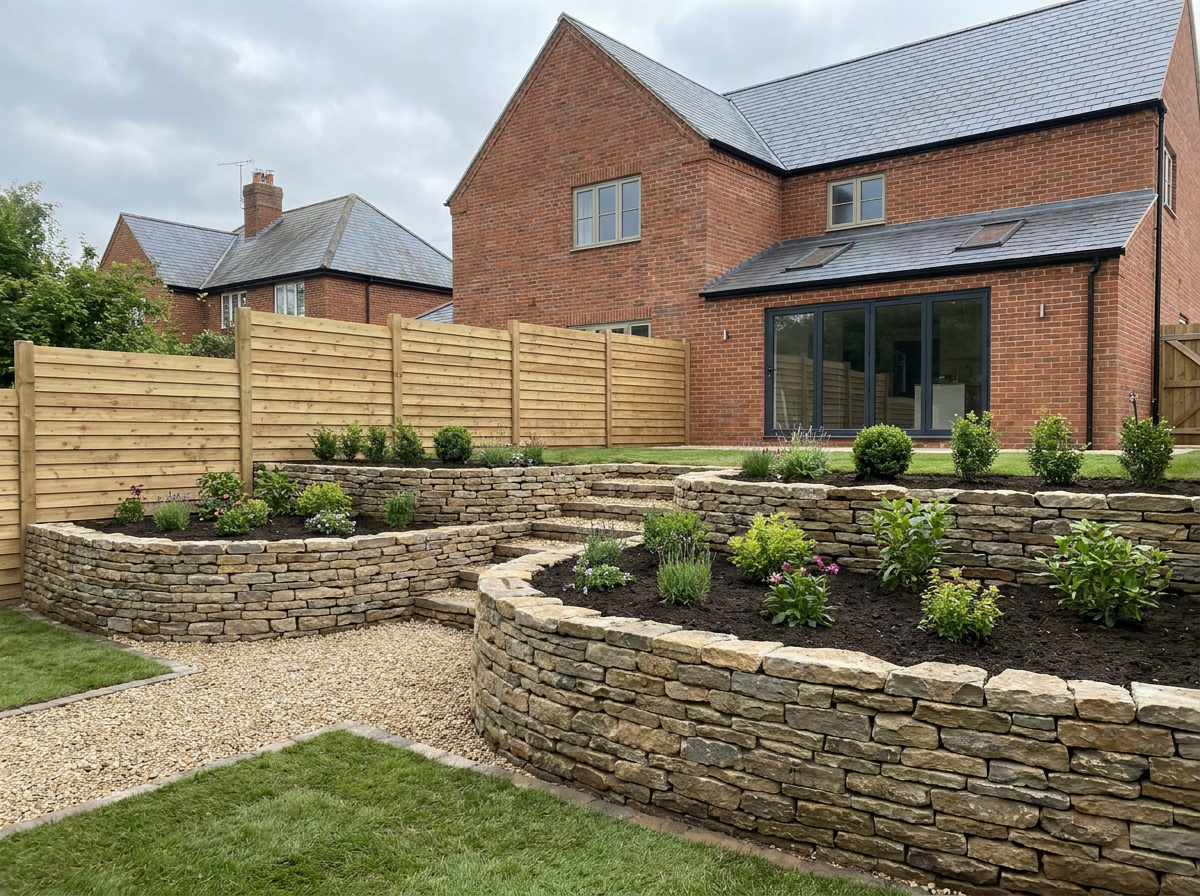
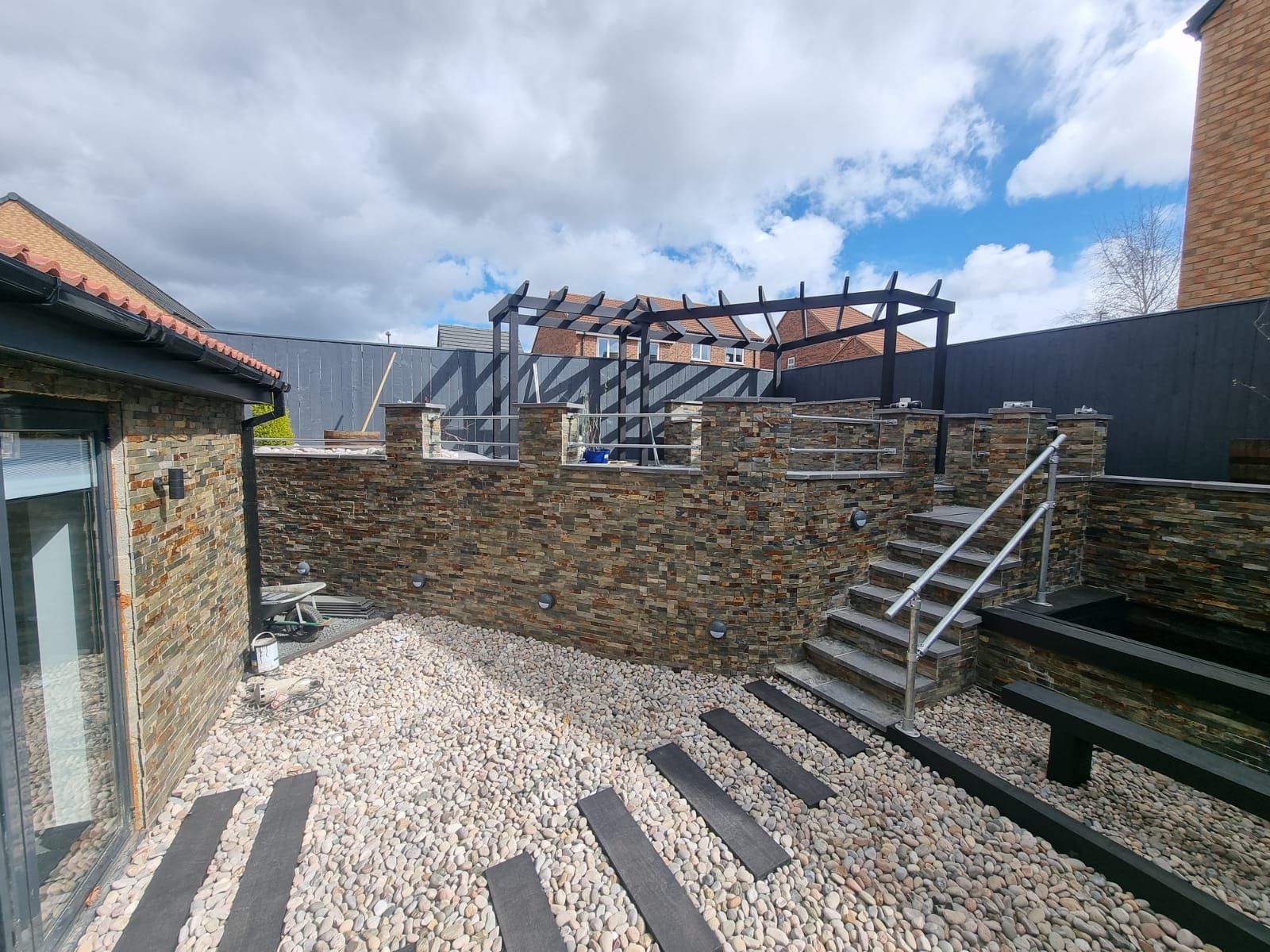
- Large patio with steps and retaining wall — add £500 to £2,000 depending on height and length
These are guide ranges. A patio on flat, accessible ground costs less than one requiring significant excavation, level changes or restricted rear access. A site visit is the only way to price accurately.
What drives patio costs up?
Several factors push patio costs significantly above the base figures.
- Sub-base depth — soft ground, made ground or significant topsoil depth means deeper excavation and more sub-base material
- Level changes — a patio stepping down from a higher garden level requires walling or retaining structures, which adds labour and materials
- Drainage — every patio must fall away from the house (typically a 1:60 fall). If the natural fall points towards the property, drainage channels are required
- Restricted access — materials carried by hand through the house or over a narrow side passage slows the job and increases the labour cost
- Material specification — standard sandstone vs premium large-format porcelain is a real cost difference; within porcelain, thinner budget products are more likely to crack during installation
- Removing an existing surface — breaking out an old concrete base or existing paving adds time, labour and skip disposal charges
What a proper patio installation involves
Understanding the installation sequence helps you assess quotes — and spot when corners are being cut.
- Excavation to the correct depth — typically 200–250mm to allow for sub-base, bedding and paving thickness
- Compacted Type 1 sub-base — at least 100mm, ideally 150mm, mechanically compacted. This is what prevents the surface sinking or shifting over time
- Edge restraints — haunched in concrete at the perimeter to stop the paving spreading at the edges
- Bedding — slabs bedded on a mortar mix; block paving on compacted sharp sand with a concrete haunch at the perimeter
- Jointing — joints filled with a suitable compound. Porcelain requires a brushable or semi-dry mortar grout; natural stone suits a sand-cement pointing mix
- Final clean-down
The sub-base is where quality is made or lost. A patio laid on inadequate sub-base will sink, shift and develop puddles within 2–3 years regardless of the surface quality. Always ask what depth of sub-base will be installed and how it will be compacted.
Porcelain, natural stone or block paving — which is right for you?
Each material has genuine advantages depending on your garden, property style and priorities.
- Porcelain — the most popular choice for contemporary gardens. Non-porous, frost-resistant, doesn't stain and looks excellent long-term. Requires experienced installation — porcelain is unforgiving if the sub-base isn't perfect. Best for homeowners who want low maintenance and a premium finish
- Natural sandstone or Indian stone — warm, natural appearance that suits traditional and period properties across Newcastle, Durham and Sunderland. Slightly more porous than porcelain and benefits from sealing. Excellent value for a quality result
- Block paving — durable, repairable, and suits both traditional and modern settings. Individual blocks can be lifted and relaid if access to buried pipes is needed. Good drainage properties with permeable jointing. Solid all-round choice
- Budget concrete slabs — functional and affordable. Lower aesthetic appeal and prone to colour fading over time, but perfectly adequate for utility areas or where budget is the priority
Things to check before work starts
A few practical points worth confirming before any contractor begins.
- Drainage route — where will surface water drain? A good contractor will discuss this before laying anything, not after
- Planning permission — patios at ground level typically don't require planning permission, but listed buildings and properties in Conservation Areas are exceptions
- Buried services — gas, water and drainage pipes may run beneath the area being excavated. A contractor should check for services before breaking ground
- Overall hard surfacing area — for driveways and larger patio areas, there are permitted development rules around the total area of hard surfacing. For a standard back garden patio this is rarely an issue, but worth checking if the project is large
Get a proper price — not a rough number
A patio quote without a site visit is a guess. Sub-base conditions, existing drainage, levels and access all affect the real cost — and they vary significantly from one North East property to the next. We carry out patio installations and outdoor landscaping projects across Newcastle, Durham, Sunderland and the wider North East. The site visit is free, the price is fixed, and the scope is written down before any work starts. Get in touch to arrange a visit.