Gardens across Newcastle, Durham and Sunderland are rarely flat. Sloping plots, heavy clay and strong winds off the coast put real pressure on fences and walls. A cheap job that ignores this fails within a few winters. Here is how to plan it properly.
Fencing options and typical costs
Prices below are typical supply-and-fit figures per metre for a standard 1.8 metre run in the North East. Access, ground conditions and removal of old fencing change the final figure.
- Treated timber lap panels: £60 to £90 per metre. Affordable and quick, but expect to replace posts sooner.
- Closeboard fencing: £90 to £140 per metre. Stronger and better on slopes.
- Composite fencing: £130 to £200 per metre. Low maintenance and long lasting.
- Concrete posts and gravel boards: add £10 to £20 per metre. Worth it in wet ground.
Posts decide how long a fence lasts
Most fence failures start at the post. Posts should be set in concrete at the right depth, usually at least a third of the post length below ground. Wind is the main enemy here, so a fence with weak footings will lean within a couple of seasons. Concrete posts cost more up front and last far longer than timber in wet clay.
When you need a retaining wall
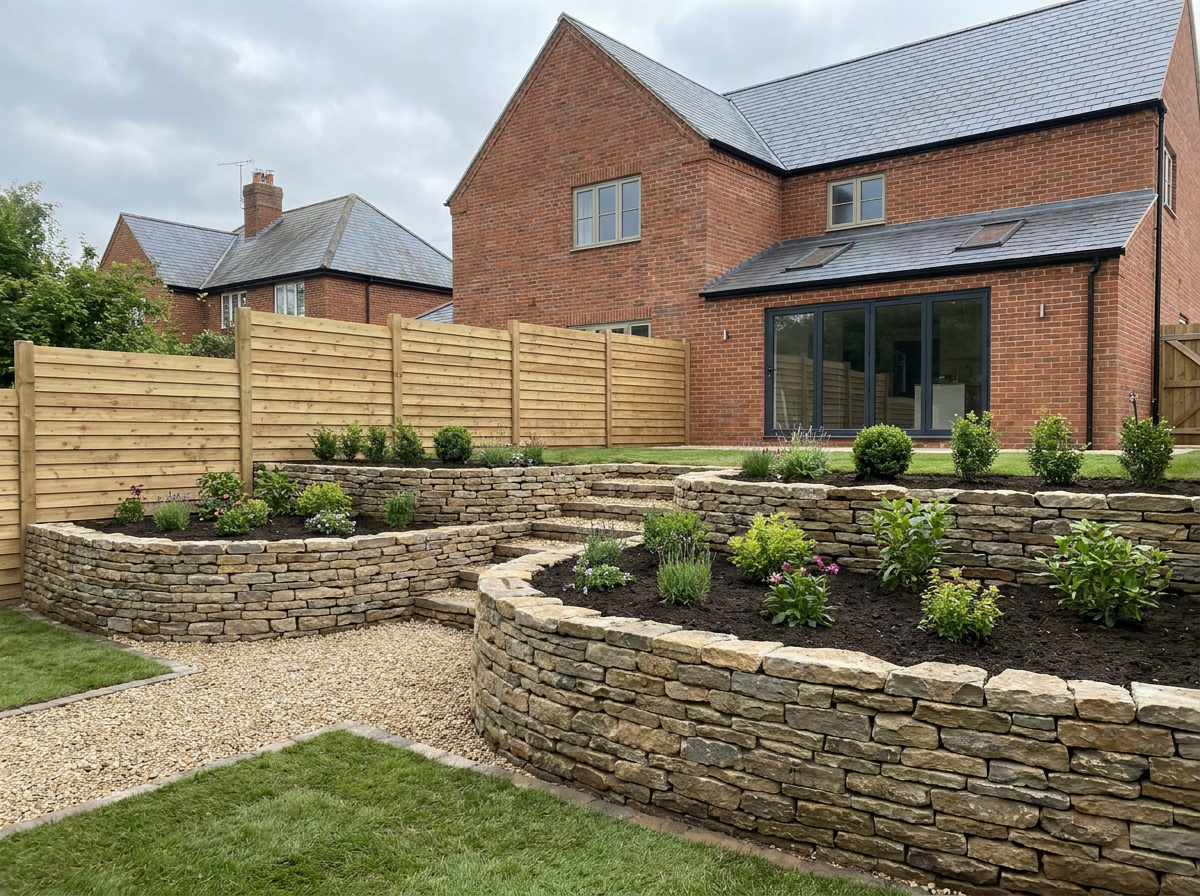
If your garden has a level change of more than about 600mm, or you want to terrace a slope for a patio or lawn, you need a retaining wall. The soil behind it carries a lot of weight, especially when saturated. This is structural work, not decoration.
- Low walls under 1 metre: brick, block or sleeper options, usually £250 to £400 per metre run.
- Taller walls: engineered design with reinforced concrete and proper drainage, from £450 per metre.
- Drainage behind the wall: a gravel backfill and perforated pipe are not optional.
Walls over about 1 metre should be designed by an engineer. Building regulations can apply, and a failed wall is expensive and dangerous.
Drainage, the part people skip
Water pressure behind a wall is the number one cause of bulging and collapse. Every retaining wall needs free-draining backfill, a drainage pipe that outlets somewhere sensible, and weep holes where the design calls for them. Skipping this saves a few hundred pounds and risks the whole wall.
Rules and neighbours
In most cases you can put up a fence up to 2 metres high at the back or side of your home without planning permission, but only 1 metre next to a highway. Listed buildings and conservation areas have extra limits. Check who owns the boundary and talk to your neighbour before work starts. It avoids disputes later.
Getting a fixed price
Fencing and retaining walls should be quoted from a site visit, not a phone call. Levels, access and drainage all affect cost. If you want a straight answer, Villa Renovations offers a free site visit and a written, fixed-price quote across Newcastle, Durham and Sunderland. We will tell you what the job needs, and what it does not.