Most North East homes were built before modern insulation standards existed. Victorian and Edwardian terraces, inter-war semis, post-war housing — the majority of properties across Newcastle, Durham and Sunderland have either no insulation, original materials that have deteriorated over decades, or partial upgrades that left significant gaps. The result is homes that are expensive to heat and slow to warm up, with walls and loft spaces losing heat that good insulation would retain. Improving your home's insulation is one of the most cost-effective investments you can make — the reduction in energy bills is immediate and sustained, and the difference to how the house feels through a North East winter is significant. The right approach depends on when the property was built, what it's constructed from, and what's already in place.
Loft insulation — the highest-return improvement
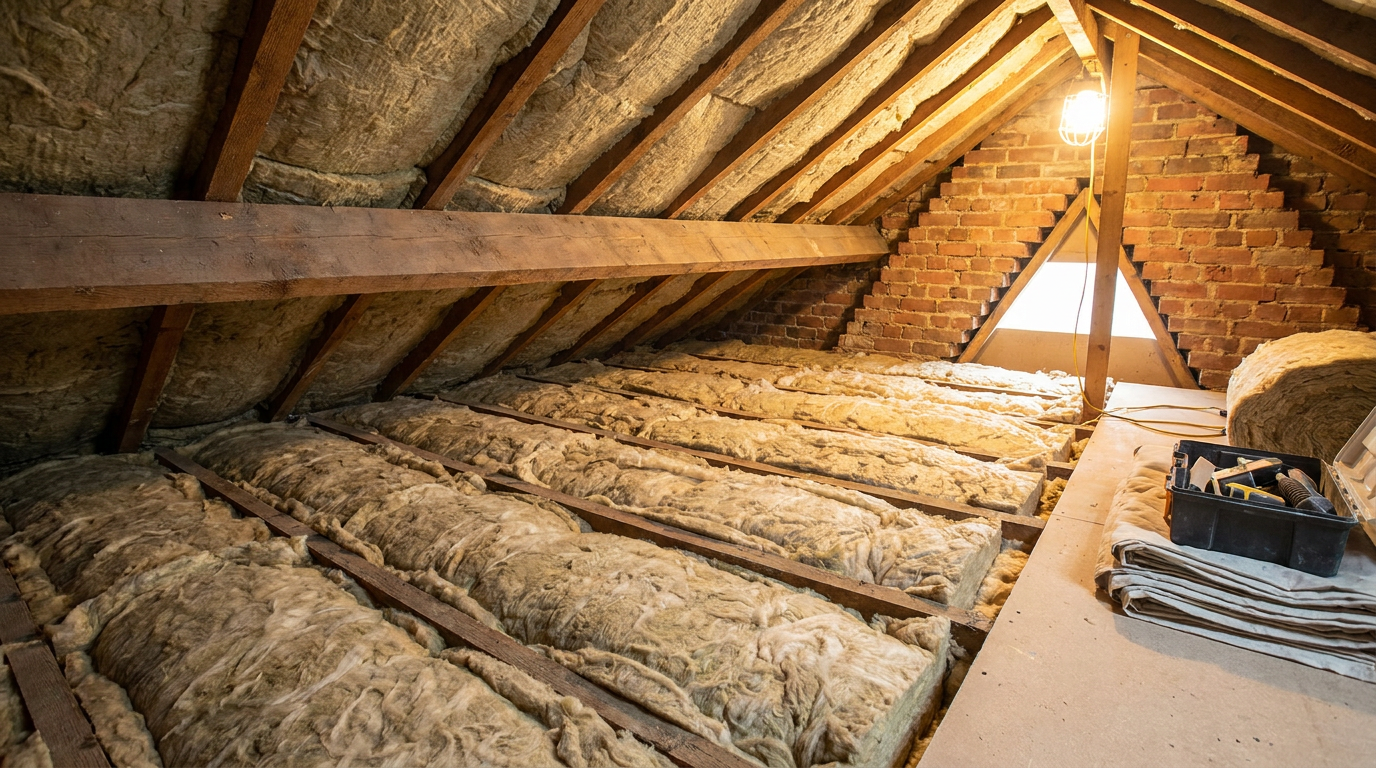
Loft insulation is the single most accessible insulation measure available to most homeowners, and typically delivers the fastest payback. Heat rises, and in an uninsulated loft it escapes directly through the roof. The current recommended depth is 270mm of mineral wool — most older North East homes have either nothing at all, or the 100mm depth that was standard in the 1970s and 1980s. Topping up is straightforward and inexpensive.
- Mineral wool rolls between and across joists — the standard approach in an accessible loft. Two layers are laid perpendicular to eliminate cold bridging at the joist positions.
- Spray foam insulation — used where mineral wool won't reach effectively, or to seal gaps at the eaves and around services. Note: spray foam applied to roof timbers can complicate future mortgage applications — check with your lender before specifying it.
- Rigid insulation board — used where headroom is limited, or where the loft space is partially converted and requires insulation at a different plane.
Realistic costs in the North East: topping up an existing partial loft to 270mm in a 3-bed semi (approx. 50m²) — £300 to £600 installed. Full installation from scratch in the same property — £400 to £800. A loft with a fixed floor will cost more, as boards must be lifted to access the joist space below.
Cavity wall insulation — most properties built after 1920
Cavity wall construction — two skins of brick with an air gap between them — became standard from the early 1920s onwards. In an uninsulated cavity, a continuous column of cold air circulates between the wall skins, drawing heat from the inner leaf. Cavity wall insulation fills that gap, dramatically reducing heat loss through the external walls. It is one of the most cost-effective improvements available to properties of this type.
- Blown mineral fibre (glass wool or rockwool) — the most widely used cavity fill material. Injected through small-diameter holes drilled in the outer leaf at regular intervals, then sealed. Very cost-effective and suitable for most standard cavities.
- Blown bead insulation (polystyrene or aerogel-impregnated bead) — marginally better thermal performance than mineral fibre, and better suited to narrower or more complex cavities.
- EPS bead with bonding agent — beads are bonded together as they're injected, preventing settling in the cavity over time. The right choice where the cavity has complex internal geometry or an irregular fill pattern.
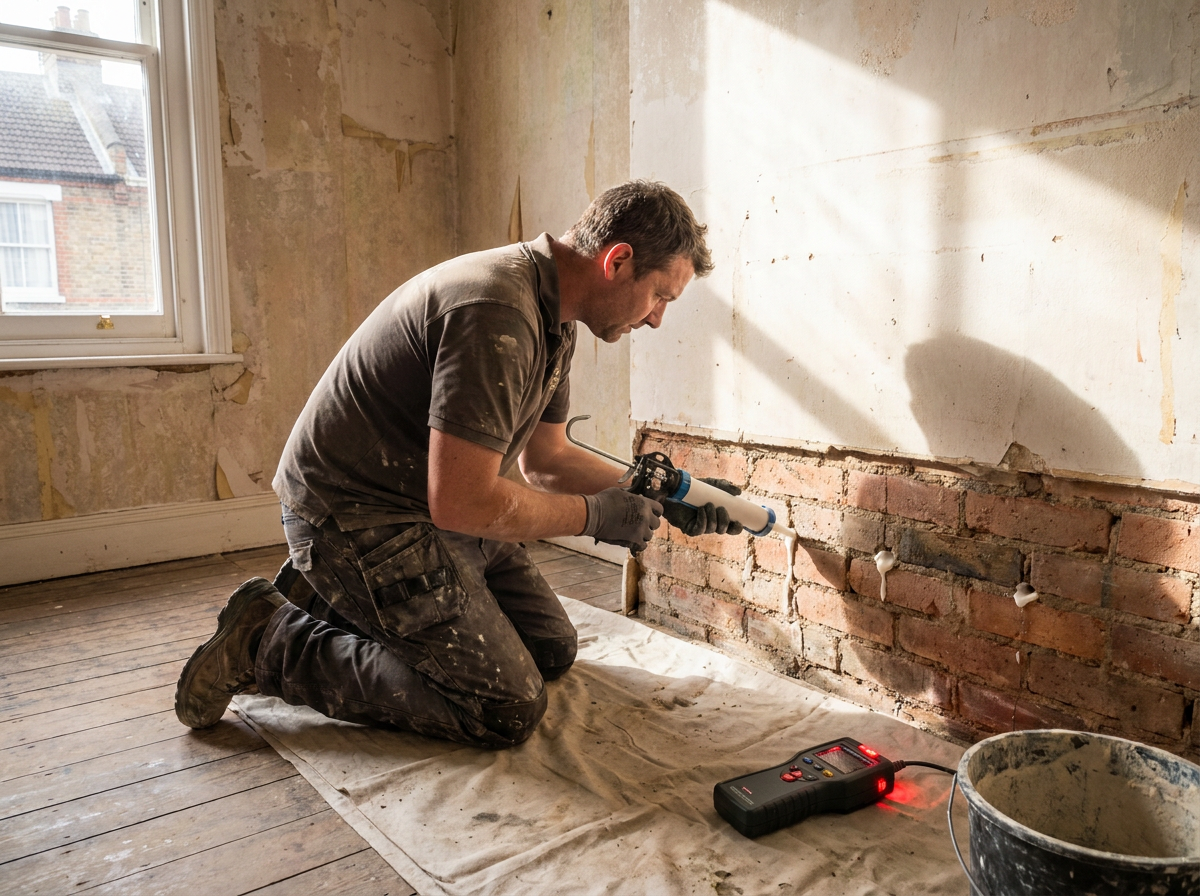
Typical cost for cavity wall insulation on a 3-bed semi-detached North East property: £400 to £900 installed, including drilling, injection and making good. Not all cavity walls are suitable — narrow cavities, significant damp ingress, or failed pointing may need to be addressed first. A survey of the wall condition before installation is standard practice.
Solid wall insulation — Victorian, Edwardian and stone properties
Properties built before the 1920s are predominantly solid wall construction — there is no cavity. Victorian and Edwardian terraces make up a significant proportion of housing in central and inner-suburban Newcastle, Gateshead, Durham and Sunderland, and they lose heat through external walls at a much higher rate than a modern insulated cavity wall. Standard cavity fill is not an option. The two solutions are internal wall insulation (IWI), fitted on the inside face of the external walls, or external wall insulation (EWI) — an insulated render system applied to the outside of the building.
- Internal wall insulation (IWI) — insulation board fixed to the inner face of external walls, then plasterboarded and skimmed. Effective, but reduces room dimensions by 80–120mm per external wall. Radiators, sockets and window boards must all be relocated as part of the work.
- External wall insulation (EWI) — rigid insulation boards fixed to the outside of the building, then finished with a render system. Preserves room sizes and addresses cold bridging more completely than IWI. Also transforms the external appearance of the property. Requires scaffold and typically significantly higher cost.
Realistic costs for solid wall insulation in the North East: IWI on a typical 3-bed semi — £3,000 to £7,000 depending on how many external wall faces are treated and the specification. EWI on a typical 3-bed semi — £8,000 to £16,000 depending on insulation thickness and render system. Both are more expensive and more disruptive than loft or cavity wall insulation, but the thermal performance improvement for a solid wall property is proportionally greater.
What affects the cost?
Beyond property size and insulation type, several factors influence the final price.
- Property size — terraced houses with shared party walls have less exposed external wall area than detached or semi-detached properties of the same floor area. Detached properties cost more to insulate than comparable terraced ones.
- Wall condition — failed pointing, damp ingress, or defective masonry must be addressed before cavity insulation is installed. Remediating these adds cost, but cannot be skipped — installing cavity insulation into a damp wall makes damp problems worse.
- Access and scaffold — EWI requires scaffold, which adds significantly to costs on a two-storey or taller property. Restricted side access or adjacent buildings with narrow gaps also affect the programme.
- Insulation thickness — a thicker insulation layer improves thermal performance but increases material costs and, on EWI, adds to the render build-up depth at window and door reveals.
- Render specification for EWI — silicone render over EWI significantly outperforms standard render in North East conditions but costs more upfront.
Grants and funding
Several government schemes offer financial support for home insulation improvements, particularly for properties with poor energy performance ratings or lower-income households.
- ECO4 (Energy Company Obligation) — energy suppliers are required to fund insulation improvements for eligible households. Eligibility is based on income, benefit status, and EPC rating. Contact a registered ECO4 installer or check gov.uk for current eligibility criteria.
- Great British Insulation Scheme — targets homes with an EPC rating of D or below and household income below set thresholds. Covers loft and cavity wall insulation in eligible properties.
- Local authority area-based schemes — Durham County Council, Newcastle City Council and Sunderland City Council all periodically run improvement schemes targeting specific streets, housing types or postcodes. Worth checking directly with your local authority.
Grant availability and eligibility criteria change regularly. Check current schemes directly at gov.uk or through a registered installer — the figures and rules are updated by government throughout the year.
Thinking about insulating your property?
Whether you need a loft top-up, a cavity wall survey and fill, or advice on internal wall insulation for a Victorian terrace, the right starting point is an honest assessment of what your property actually needs. We carry out insulation surveys and installations across Newcastle, Durham, Sunderland and the wider North East — including IWI and EWI on solid wall properties as part of larger renovation projects. All work is scoped and priced in writing before it starts, with no surprises on the final invoice. Get in touch to arrange a free site visit.