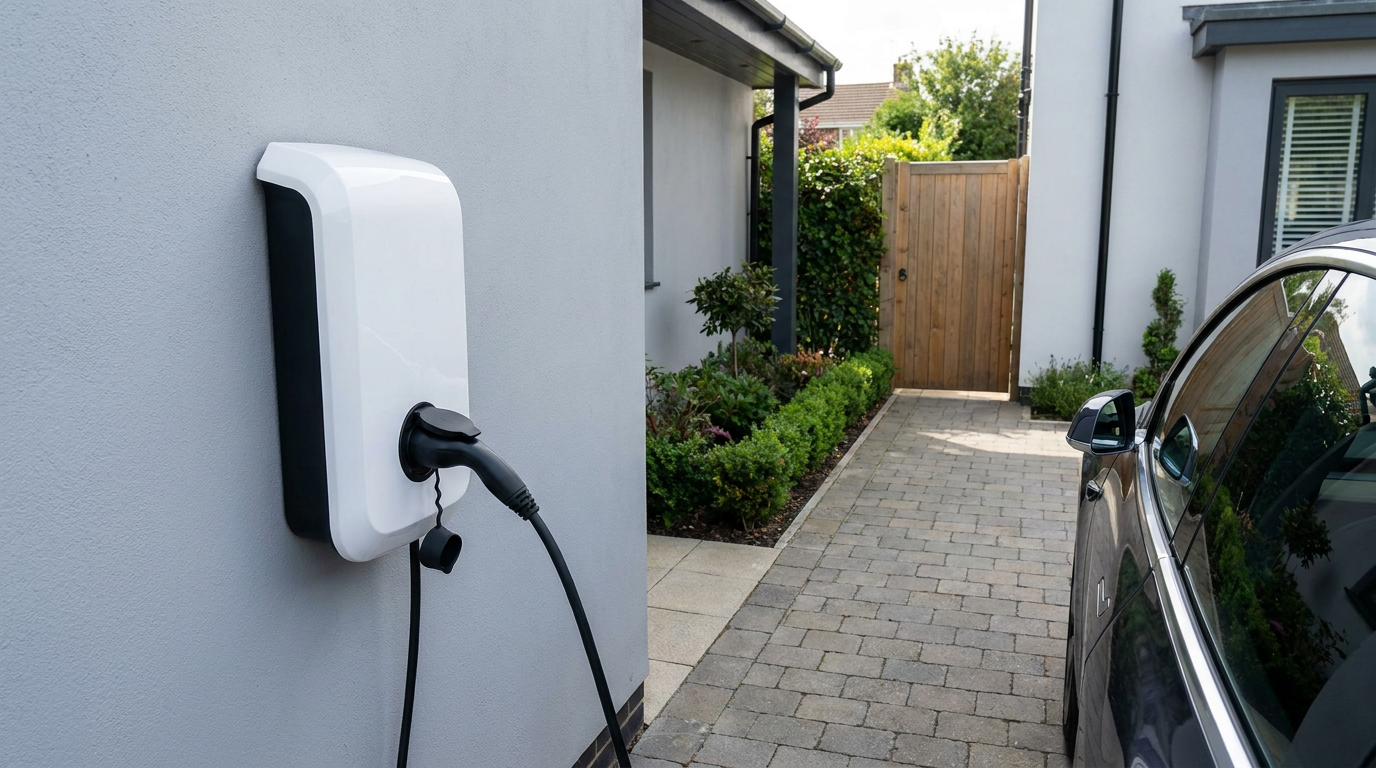
Electric vehicles are no longer a novelty in the North East. With more homeowners in Newcastle, Durham and Sunderland switching from petrol and diesel, the question of how to charge at home has become a practical one for a growing number of households. A standard three-pin plug will charge an EV — slowly and inefficiently. A properly installed home charging point (also called an EVSE, or electric vehicle supply equipment) is faster, safer, and significantly more convenient. Here's what installation actually involves, what it costs, and what funding is available.
Do you actually need a dedicated charger?
Technically, you can charge any electric vehicle from a standard 13A domestic socket using a portable cable your vehicle comes with. In practice, this is not a good long-term solution.
- Speed — a standard socket delivers around 2.3kW, adding roughly 8–10 miles of range per hour. A dedicated 7.4kW home charger adds 25–30 miles per hour, fully charging most EVs overnight.
- Safety — drawing 10–13 amps continuously through a standard socket for 8–12 hours puts sustained load on a circuit that was not designed for it. Dedicated charging circuits are wired to handle this safely.
- Convenience — a wall-mounted unit with a tethered or socketed cable is more practical than using the portable cable every night.
- Smart features — most home chargers include smartphone apps, scheduled charging (to charge during cheaper off-peak tariff periods), and energy monitoring. None of these are available from a standard socket.
If you have a time-of-use electricity tariff — such as Octopus Go or similar — a smart charger that schedules overnight charging during low-rate periods can save you a significant amount annually. The charger pays for itself faster than most people expect.
Types of home EV charger
Residential home charging units are almost all single-phase 7.4kW units. There are two main variants.
- Tethered charger — the cable is permanently attached to the unit, like a petrol pump. Convenient and fast to use. The right choice if all vehicles in the household use the same connector type (Type 2 is standard for most modern EVs in the UK).
- Socketed charger — the unit has a Type 2 socket rather than a fixed cable. You plug in your own cable. More flexible if you use different vehicles, but slightly less convenient day-to-day.
- Three-phase 22kW chargers — available for residential properties with a three-phase supply. Most North East homes have single-phase supplies; upgrading the supply for a 22kW charger is rarely cost-effective for domestic use unless the property is already three-phase.
The brand and model of charger matters more than most people realise. Budget units from unknown brands can have unreliable apps, poor longevity, and limited compatibility with smart tariffs. Brands like Zappi, Ohme, Wallbox and Myenergi have established track records for UK residential installations.
What does EV charger installation involve?
A straightforward home EV charger installation on a standard North East semi-detached or terraced property involves the following.
- Survey — the installer assesses the existing consumer unit (fuse box), available capacity, and the most practical cable route from the unit to the intended charger location.
- Dedicated circuit — a dedicated circuit (typically 32A or 40A) is run from the consumer unit to the charger location. This typically runs through the garage, loft, or along external walls depending on the property layout.
- Consumer unit check — if the existing consumer unit is full or outdated (particularly older split-load boards without the correct protective devices), an upgrade or addition may be required before the circuit can be added safely.
- Charger mounting and connection — the unit is wall-mounted and the circuit connected. The charger is configured, the app set up, and the installation tested and certified.
- Certification — all EV charger installations are notifiable electrical work under Part P of the Building Regulations. A completion certificate must be issued by the installer.
The cable route from the consumer unit to the charger is the most variable part of any installation. A charger installed on the front of a house, with a consumer unit at the rear, requires more cabling and conduit than one directly outside a utility room. This is the most significant factor in pricing, alongside whether the consumer unit needs any work.
How much does home EV charger installation cost in the North East?
These are realistic supply-and-install costs in Newcastle, Durham, Sunderland and the wider North East.
- Standard installation — single-phase 7.4kW tethered or socketed charger, straightforward cable route from consumer unit, no additional consumer unit work required: £600 to £950 all-in.
- Installation with longer cable route (front of property, difficult access) — £750 to £1,200.
- Installation requiring consumer unit upgrade or additional MCB — £900 to £1,500 depending on the scope of consumer unit work.
- Charger unit cost (included in above) — £200 to £450 depending on brand and specification. Mid-range smart chargers from established brands (Zappi, Ohme, Wallbox) typically cost £280 to £380.
Always ask for the charger model and brand to be specified in the quote. A quote that says 'smart charger' without naming the unit may be for a budget product with limited smart tariff compatibility. The charger is a long-term installation — the brand choice matters.
Grant funding — what's available?
The government's Electric Vehicle Homecharge Scheme (EVHS) previously provided grants for domestic EV charger installation. This scheme closed to homeowners in April 2022 and is now only available for renters and flat owners. However, other funding may be available.
- EV chargepoint grant for renters and flat owners — up to £350 (75% of installation cost) for people who rent their home or live in a flat. Requires an OZEV-approved installer. Check gov.uk for current eligibility.
- Workplace Charging Scheme — businesses and organisations (including commercial landlords) can apply for a grant of up to £350 per socket for workplace charging points. Relevant for commercial clients and landlords.
- Local authority schemes — Newcastle City Council, Durham County Council and Sunderland Council have all run EV infrastructure schemes. Check directly with your local authority for any current residential or community charging support.
- Energy supplier deals — some energy suppliers offer subsidised or bundled EV charger installation when you switch to a smart EV tariff. Worth checking with your supplier before paying full price.
Practical considerations before installation
A few things worth checking before booking installation.
- Off-street parking — a home charging point requires off-street parking at the property. Running a cable across a public pavement to charge on the street is not permitted.
- Consumer unit location — the further the consumer unit is from the intended charger location, the longer the cable run and the higher the labour cost. Know where your fuse box is before asking for a quote.
- Electricity supply capacity — most North East homes have a 60A or 100A incoming supply. A 7.4kW charger draws around 32A, which works comfortably within a standard supply. If you also have an electric shower, underfloor heating, or other high-draw appliances on simultaneously, it's worth checking available capacity.
- Future-proofing — if you're having other electrical work done (consumer unit upgrade, rewire, extension), having the EV circuit installed as part of that programme is more cost-effective than a separate return visit.
If you're having a driveway or garage conversion done, it makes sense to route EV charger cabling as part of that work — even if the charger itself isn't being installed yet. Adding conduit and a spur while walls and floors are open costs very little; adding it later means more disruption and higher labour costs.
Thinking about an EV charger?
Whether you're buying your first electric vehicle or have already been relying on a three-pin socket for too long, a properly installed home charging point makes everyday EV ownership significantly more practical. We install EV charging points across Newcastle, Durham, Sunderland and the wider North East — all Part P certified, all scoped and priced before work starts. If you're also planning other electrical work, we can combine both programmes for better value. Get in touch to arrange a free site visit and a fixed-price quote.