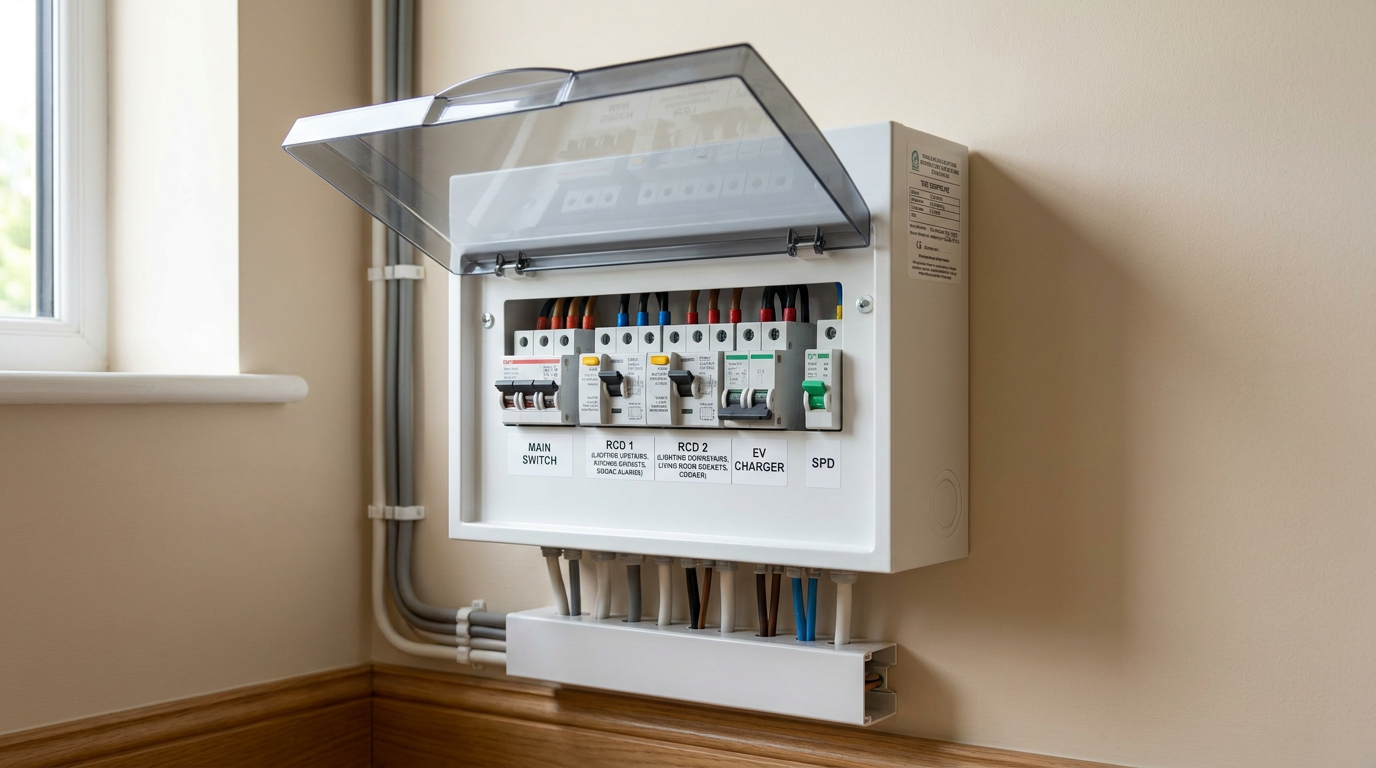
The consumer unit — the fuse box or distribution board on a wall in your hall, cupboard, or garage — controls every electrical circuit in your property. In most modern UK homes it contains a row of miniature circuit breakers and residual current devices that protect both the wiring and the people living there. In older North East homes, it might be something considerably less capable: a split-load board from the 1980s, a fusebox with rewirable fuses, or an installation that predates modern protection standards entirely. An outdated consumer unit is not just inconvenient — it's a genuine safety issue and a problem that surfaces whenever you add circuits, extend the property, or put it on the market. This guide explains when you need a replacement, what the work involves, and what it costs in Newcastle, Durham and Sunderland.
What a consumer unit actually does
The consumer unit is where the incoming mains supply is divided into the individual circuits that serve different parts of your home — ring mains, lighting, cooker, shower, EV charger, and any others. Every circuit originates here. A modern board does three essential things.
- Protection against overload and short circuits — MCBs (Miniature Circuit Breakers) are rated for the maximum current each circuit should carry. If a fault causes current to exceed that rating, the MCB trips and isolates the circuit before the wiring overheats.
- Protection against earth leakage — RCDs (Residual Current Devices) detect tiny imbalances in the current flowing through a circuit. Even a small fault current — the kind caused by electricity passing through a person — trips the RCD in milliseconds. This is a critical life-safety feature that older installations without RCD protection simply cannot provide.
- Control and isolation — individual circuits can be isolated for maintenance, and the whole installation can be switched off via the main isolator switch.
When does a consumer unit need replacing?
There are several situations where a consumer unit replacement is either necessary or strongly advisable.
- It contains rewirable fuses — rewirable fuses need to be manually replaced when they blow and can be incorrectly rewired with wire of the wrong rating. Any installation with rewirable fuses should be upgraded.
- No RCD protection — older boards may have MCBs throughout but no RCD protection. The 18th Edition Wiring Regulations (BS 7671) require RCD protection on most circuits in domestic installations. An unprotected board is a real risk.
- You're adding circuits — fitting an EV charger, extending the kitchen, adding underfloor heating, or any new circuit to a full board means either a board change or a secondary board. Replacing the board at that point is usually more cost-effective and neater.
- You're selling the property — an outdated consumer unit will be noted on a buyer's survey and used as a negotiating point. Upgrading before marketing removes the objection.
- An EICR has found the board unsatisfactory — a C1 (dangerous) or C2 (potentially dangerous) finding requires a replacement. For rental properties, any unsatisfactory finding must be remedied within 28 days.
- The board has been damaged or modified — scorch marks, evidence of overheating, non-standard additions, or a board that doesn't match the circuits it serves are all reasons to replace.
An EICR (Electrical Installation Condition Report) is required every five years on all private rental properties in England. It inspects and tests the electrical installation and identifies faults, deterioration, and out-of-date protection. A consumer unit replacement addresses the most common source of unsatisfactory grades in older North East properties.
What the installation involves
A consumer unit replacement on a standard residential property in Newcastle, Durham or Sunderland follows a clear sequence.
- Site survey — the electrician assesses the existing installation: number of circuits, their condition, the incoming supply rating, and the earthing and bonding arrangement. This determines what board is needed.
- Isolation of supply — the incoming supply is isolated at the meter and all circuits de-energised.
- Removal and replacement — the existing unit is removed and the new board installed. Each circuit is connected to the new MCBs and RCDs, correctly identified and labelled.
- Bonding check — supplementary bonding to gas, water, and structural metalwork is checked and updated to current standards if required.
- Testing — each circuit is tested for continuity, insulation resistance, and RCD trip times. Proper testing is what turns an installation into a certified one.
- Certification — an Electrical Installation Certificate is issued on completion. This is a document you'll need when selling the property.
During the installation the electricity supply will be off for part of the day — typically several hours. On a straightforward board swap, this is usually manageable in a single visit. Work involving additional circuits or first-fix wiring alongside the board change will take longer.
How much does a consumer unit replacement cost in the North East?
These are realistic supply-and-fit costs for consumer unit replacements in Newcastle, Durham, Sunderland and the wider North East.
- Standard consumer unit replacement — existing installation in reasonable condition, new dual RCD or RCBO board, full testing and Part P certification, 3-bed semi-detached: £350 to £600
- Consumer unit replacement including replacement of consumer unit tails (cables from meter to board): £450 to £700
- Consumer unit replacement combined with EICR — having both done together avoids two separate callout costs: typically £550 to £850
- Consumer unit replacement with remedial works — bonding upgrades, additional circuit repairs identified during testing: £500 to £1,000+ depending on scope
- Larger property with higher circuit count (4-bed detached): £450 to £800 for the board replacement alone
These figures cover the consumer unit replacement. If the EICR that prompted the upgrade also identified faults in individual circuits — damaged cables, failed sockets, missing earth connections — those are additional costs. A site survey before work starts identifies these so the full scope is priced before anything begins.
Building Regulations and certification
Consumer unit replacement is notifiable electrical work under Part P of the Building Regulations. It must be carried out by a registered competent person — an electrician registered with a scheme such as NAPIT, NICEIC, or Elecsa — who self-certifies the work, or it must be notified to and inspected by Building Control.
- An Electrical Installation Certificate (EIC) must be issued on completion, certifying the work meets BS 7671 (18th Edition Wiring Regulations)
- Keep the EIC — it is documentation you will need when selling the property, and for rental properties it is part of your compliance record
- For landlords, work must be completed and certified before the 28-day remedial deadline if the EICR returned an unsatisfactory grade
- Always check that the electrician you appoint is registered with a recognised competency scheme — ask to see their registration before work begins
Thinking about your consumer unit?
Whether an EICR has flagged an outdated board, you're adding circuits for an EV charger or extension, or you want to remove a common survey objection before selling, a consumer unit replacement is a straightforward job when scoped and priced correctly from the start. We carry out consumer unit replacements, full rewires, EICR inspections, and electrical installations across Newcastle, Durham, Sunderland and the wider North East. All work is certificated to Part P and BS 7671 standards, and every job is scoped and priced in writing before work begins. Get in touch to arrange a free site visit and a fixed-price quote.